|
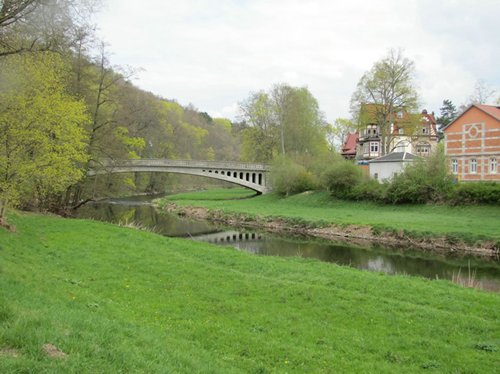 River at Meiningen River at Meiningen
To plan the trip, we downloaded a river map from the Werra valley tourist association site. The map shows getting in and getting out places and the weirs.
We referred to the DKV river description which says that the river is canoeable all year from Meiningen downwards.
We also purchased from amazon.de for 10 Eur a book describing the cycle route along the Werra. The book has 1:50000 detailed maps of the complete route and information about what is worth visiting in the area.
In February when we started thinking about paddling the river Werra in April, I only imagined it would be cold and wet. In fact it turned out to be the best weather we have ever had during a holiday. I have been close to the area previously at the beginning of May and it has always been extremely cold. While making plans we discovered that most of the camping sites, especially in the upper river only open from May. However there are many guest houses and hotels relatively close to the river and inexpensive and so we decided to make our first HOTEL canoe trekking trip.
There are numerous weirs along the river so it also did not seem a bad idea to take less luggage and make the portaging easier. Facilities for portaging in Germany and generally good and this river was no exception. At each weir, there were canoe landing stages, information boards showing not only the portage path, but telling us about the local area.
We started in Meiningen and paddled to Eschwege, a distance of 170 km. We portaged past 19 weirs and 1 fallen tree blocking the river. In Eschwege, by the final weir of our trip, there was also a lock which we used for fun. It actually took longer to operate the lock than portage. Staying at hotels meant that we had plenty of time for tourist activities and late afternoon walks in the wooded areas surrounding the river.
The river starts small with many bends and you cannot see much of the surrounding landscape while on the river. After Bad Salzungen the river bed broadens and you get distant views of the surrounding hills while paddling. There was a major flood in January this year which meant that for the first few days we saw lots of plastic rubbish in the trees high above the river. Fortunately as the river got broader, the rubbish vanished from view.
The first few days you are aware of the industry in the river valley, mainly the potash mine. We visited the mine which was interesting. Besides having a cave with the largest salt crystals I have ever seen, there is another cave where the Nazis hid their gold reserves during WW II. The cave was visited by General Eisenhower in 1945 when the gold was uncovered by Allied forces in 1945.
We also visited a mining museum which gave more insight into the development of the area.
Further downstream as the river broadens, the industry is left behind and the area is rural with rolling hills.
The reeds growing along the river looked as if they had salt on them, and this was confirmed by canoeists and fishermen we talked to, who are not happy that so much salt from the potash industry finds its way into the river.
Day 4 of our trip was hard going as we had to carry past 5 weirs. This was the center of the potash mining area and at the beginning of the last century when the mines were developed, each mine had to generate its own electricity – hence the large number of weirs in such a short distance.
Dotted along the river are many small towns and villages with timber frame houses – all very picturesque.
We paddled for 6 days without seeing another boat on the river. On days 7 and 8, Easter Saturday and Sunday, we encountered a group of Germans all paddling double kayaks. The canoe rental companies were all closed despite the sunny weather and temperatures of 25 C so we enjoyed the river alone.
In the town of Vacha, while wheeling the canoe thru the streets to the hotel, we bumped into a television crew making a documentary “Round and about in Thuringen”. They asked us if they could film us the following morning leaving the hotel, and walking the boat back down to the river. The program will be shown shortly on German television!< /span >
In conclusion we really enjoyed our first HOTEL canoe trek. All the hotels were friendly and in 4 hotels we were offered a garage for storing the boat. At other hotels, we left the boat in the beer garden.
There are good train connections in the area. Before starting the trip, after unloading everything at the start, we drove to the finish, and took trains back to the start. We left the car in the hotel car park of our final night’s stay.
Further, the river continues for another 60 km until it joins the river Weser in Han-Munden. We had wanted to do this as well but had not enough time.
The most popular part of the river for canoeists is the stretch from Creuzburg to Han-Munden. However I am glad we paddled also the industrial area and experienced more aspects of the river.
|
